At COP31 - Countries Embrace Satellite Data to Lead on Methane
Published on: Nov 23, 2026
Government leadership key in translating observations from space into methane action on the ground
As country leaders assembled at the UN Climate Change Conference (COP31) in Antalya, Türkiye, methane emissions were at the center of the agenda. Despite a challenging end to the negotiations, there were many moments of real leadership that countries displayed throughout the week, especially on tackling methane. Representatives of Kazakhstan, Brazil, and Chile took to the COP31 stage — alongside Carbon Mapper, Clean Air Task Force, Global Methane Hub, and other partners — to announce new ways they are addressing methane super-emitters from the oil and gas and waste sectors, and how they plan to leverage the power of satellite data to help.
Making Methane Visible and Actionable
Methane is a super-potent greenhouse gas that is responsible for roughly 30% of climate warming and is the second-largest contributor to climate change after carbon dioxide. Although methane has a shorter atmospheric lifespan, it has roughly 80 times the global warming potential of CO₂ over a 20-year period, making reductions in methane emissions particularly important for slowing near-term warming.
Emissions-sensing satellites are revolutionizing how we understand and act on methane. Carbon Mapper is using a growing constellation of satellites to deliver granular public data that helps decision makers pinpoint the locations of large methane events around the globe. Beyond the data, we’ve been working to scale action quickly — proving that if we make methane visible and accessible, emissions can be stopped. In October, Carbon Mapper joined our partners at Planet Labs to launch the Tanager-2 satellite as part of our longstanding plans to grow our constellation. More coverage across more locations strengthens the scientific and evidentiary basis regulators and legislators rely on and supports expansion of policy engagement into more states and countries.
Governments Leading the Charge
Governments have been a key partner in proving that states and countries can utilize satellite methane data derived from Tanager satellites to successfully identify and mitigate methane super-emitters from the oil and gas and waste sectors.
In 2025 California led the way through the creation of the California Satellite Methane Project, which uses Carbon Mapper methane data derived from Planet's Tanager-1 satellite to enable rapid notification and response on oil and gas and waste methane sources across the state.
This year, at COP31, other countries are building on this momentum and have stepped up to lead.
Here is a snapshot of innovative ways countries are looking to translate data from space to action on the ground.
Seizing the Oil and Gas Super-Emitter Opportunity
Kazakhstan
Kazakhstan is a country where oil and gas super-emitters have a large impact. But it has also emerged as a global leader in addressing methane from the sector. At COP31, the Ministry of Ecology and Natural Resources of Kazakhstan announced plans to develop a national satellite-based program to regulate methane emissions from the country's oil and gas sector. This latest announcement is a major step in translating commitments to targeted mitigation action.
The program will use satellite and aerial data to identify large methane releases at oil and gas facilities and pass that information to regulators and operators so that detection leads to verified repairs. Carbon Mapper will support this effort by providing actionable data and helping to build in-country capacity in using that data to guide notification, and verification of mitigation success.
This will complement Kazakhstan's requirements on leak detection and repair, flaring, and venting. The program builds directly on the MOU signed in September 2025 by the Ministry of Ecology, the Global Methane Hub, Carbon Mapper, and CATF.
Kazakhstan joined the Global Methane Pledge in 2023, and has been working with international partners to implement stricter monitoring and regulations across its energy infrastructure. At COP30, it signed a joint statement ("Drastically Reducing Methane Emissions in the Global Fossil Fuel Sector") to push for near-zero intensity targets, end routine flaring and venting by 2030, and adopt Oil and Gas Methane Partnership 2.0 standards.

Representatives from the Kazakhstan Ministry of Ecology and Natural Resources, Carbon Mapper, and Clean Air Task Force at COP31.
Tackling Waste Sector Emissions
Brazil
At COP31 Brazil shared how it plans to advance national efforts alongside partners to use satellite technology to identify and mitigate emissions from waste super-emitters in the country.
Brazil’s waste sector has an outsized climate impact and immediate mitigation potential. A select number of sites have highly persistent emissions, and addressing them now can make immediate climate progress while also preventing emissions that may have continued for years on end. Satellite data has not only made this opportunity clear, it has also revealed where mitigation efforts can be prioritized, both at the country level and within specific landfills.
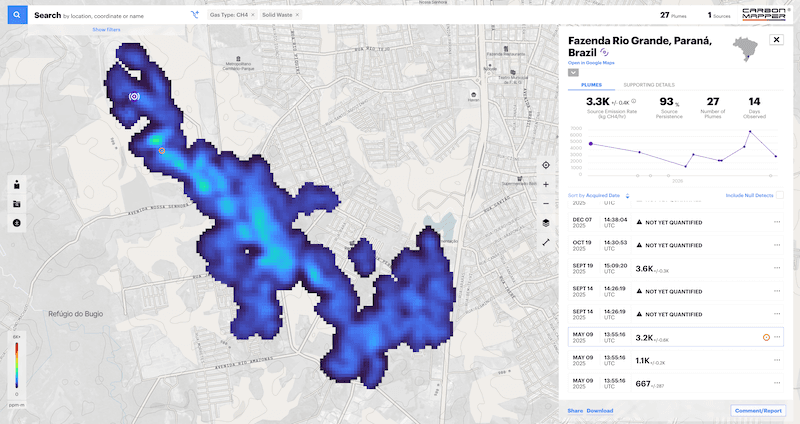
A large plume of methane stemming from a waste facility in Brazil observed by Planet’s Tanager-1 satellite in Sep. 2026. Source: Carbon Mapper data portal
This progress builds upon past efforts. At COP30 the Government of Brazil, CATF, and Carbon Mapper announced the launch of a process to develop a first-of-its-kind initiative to detect and mitigate methane emissions from the country’s waste sector, using cutting-edge satellite and remote sensing technologies. Since then, Carbon Mapper and other partners have worked with government stakeholders to learn how to effectively use remote sensing data, growing the confidence and capacity needed to expand their waste methane efforts.
Chile
A COP31 roundtable discussion explored how Chile is moving toward a methane emissions standard for landfills. Experts specifically highlighted how satellite methane data and global partnerships can help Chile identify the biggest mitigation opportunities at landfills, strengthen measurement, reporting, and verification (MRV) and its national greenhouse inventory, and track emissions reductions.
Chile has been a longtime leader that leverages remote sensing to gather data on methane emissions from the waste sector, and is now putting data into practice.
It is a signatory to the Global Methane Pledge, and at COP27, Chile announced its intent to accelerate methane reductions and updated its National Determined Contributions.
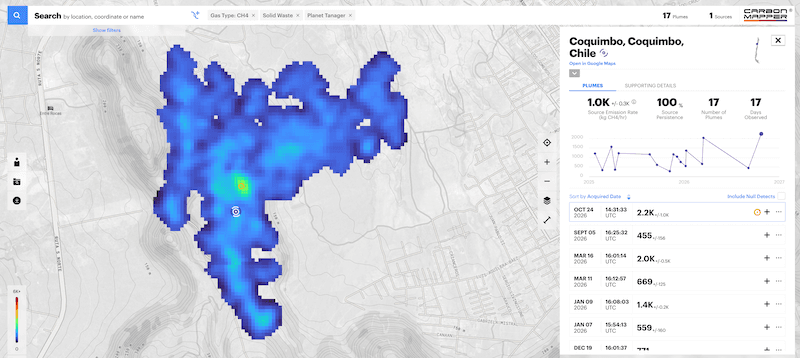
A large plume of methane stemming from a waste facility in Chile observed by Planet’s Tanager-1 satellite in Oct. 2026. Source: Carbon Mapper data portal
To lay the groundwork, in 2023 Carbon Mapper conducted an airborne methane survey in partnership with Chilean ministries and the Global Methane Hub to detect point sources that potentially emit disproportionately high volumes of methane and therefore offer important mitigation opportunities. This survey delivered new insights on methane emitted from key sectors and regions in the country, and also contributed to a broader understanding of Chile’s methane budget.

Representatives from the Global Methane Hub, Carbon Mapper, and Chile’s Ministry of Environment gathered at COP31 on Nov. 18 for a panel discussion on the country’s experience using remote sensing technology to address methane from the waste sector.
Scaling Global Action
Carbon Mapper’s collaborations with governments show three things: first, Carbon Mapper’s public data is valuable to countries because it offers a science-based resource that can instill confidence and provide direction. Second, when leaders are successful, others are quick to follow. Third, as the number of our satellite observations has grown, so too has the number of those acting on them.
We applaud the leadership of governments at COP31 to take methane action to new heights, and are doing our own part in support.