Global Data to Drive Local Methane Action
Published on: Feb 27, 2026
This year marks the 250th anniversary of the discovery of methane — a milestone for both science and global efforts to tackle climate change and energy security.
Reducing fugitive methane emissions is one of the fastest and most cost-effective levers available to slow near-term warming. A small subset of large, localized methane emissions – often called super-emitters – present a meaningful opportunity to pull the emergency break for immediate action across key emitting sectors and regions worldwide.
Transparent, accessible, and high-resolution satellite methane data is making it possible to move from broad national methane commitments to data-informed, facility-level action. By pinpointing some of the largest sources of methane, Carbon Mapper analyzes observations from Planet’s Tanager-1 satellite to give governments, industries, and communities a clearer roadmap for swift reduction efforts.
A year of data from the Tanager satellite has enabled Carbon Mapper to identify some of the most high-impact opportunities observed to date — areas where targeted mitigation of large, point source emissions events can deliver significant reductions in oil and gas basin emissions and help meet national waste-sector reduction goals.
Leveraging Data to Inform Methane Mitigation Planning in the Waste Sector
Many countries are already incorporating waste-methane reductions into their Nationally Determined Contributions and committing to cut methane from organic waste under programs like the Reclaiming Organic Waste Declaration and the LOW-Methane Initiative.
Carbon Mapper assessed thousands of methane plumes from a year of high-resolution Tanager satellite data to identify many of the world's largest methane-emitting landfills and dumpsites. In some countries, addressing even a subset of these high-emitting landfills could significantly reduce national waste-sector emissions.
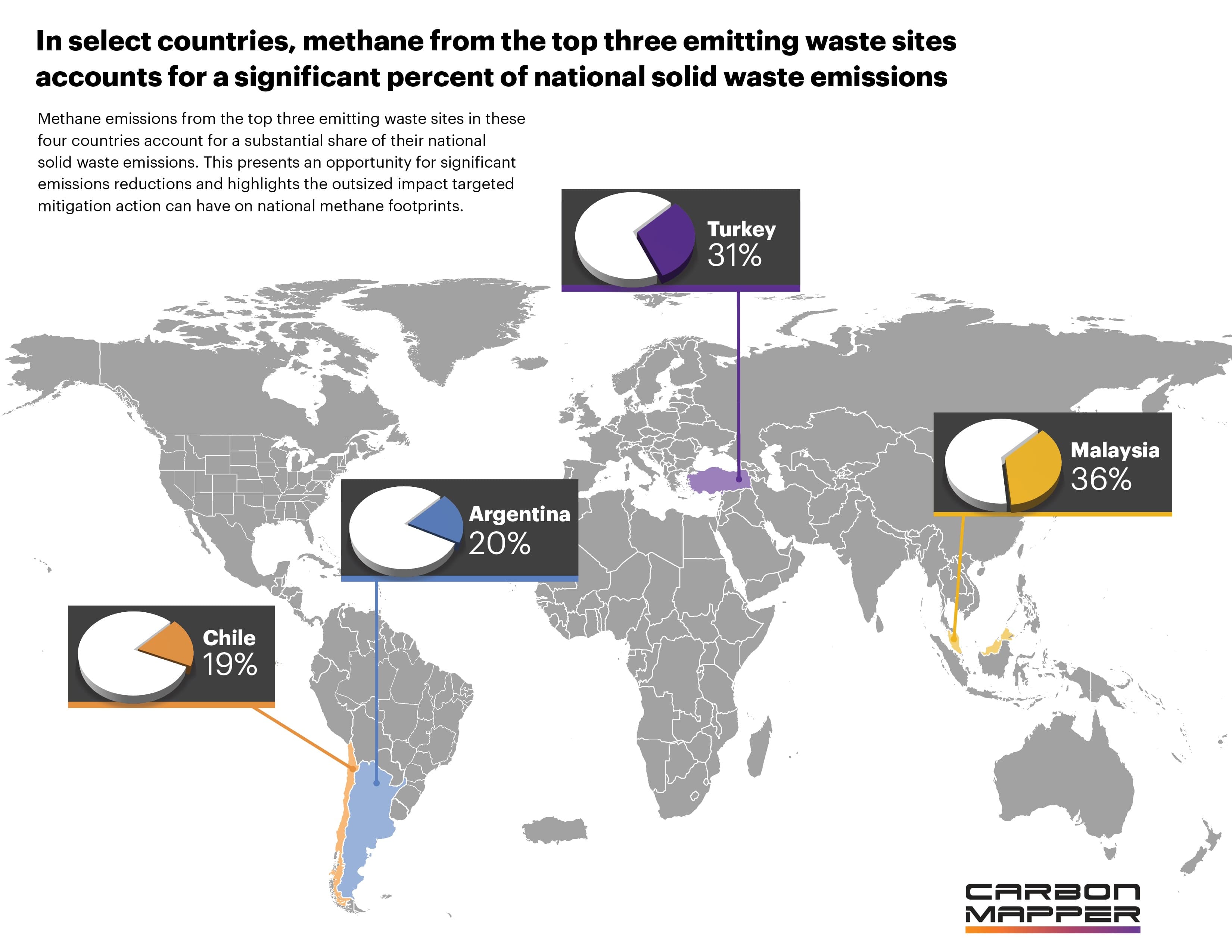
Methane emissions from the top three emitting waste sites in these four countries account for a substantial share of their national solid waste emissions. This presents an opportunity for significant emissions reductions and highlights the outsized impact targeted mitigation action can have on national methane footprints.
For example, in Turkey, Argentina, Chile, and Malaysia, Carbon Mapper data collected between August 2024 and October 2025 show that just three waste sites account for roughly 19-36% of national solid waste emissions in each country. Targeted site-level mitigation at only a handful of these facilities would deliver substantial national-level reductions.
Taking action on large and persistent waste methane sources — through improved landfill monitoring and management, alongside accelerated organic waste diversion to help address the systemic drivers of waste emissions — can help turn satellite insights into measurable climate wins while also creating more resilient waste systems and improving public health.
Some countries are seizing the waste opportunity to demonstrate global methane leadership and leveraging satellite data to help them do so. For example, at COP30, the Government of Brazil, Clean Air Task Force and Carbon Mapper announced the launch of a process to develop a first-of-its-kind initiative to detect and mitigate methane emissions from the country’s waste sector, using cutting-edge satellite and remote sensing technologies.
Persistent Oil & Gas Methane Emitters: High-Impact Reductions and Real Economic Opportunities
Some methane sources with high emissions rates release gas in short, powerful bursts, while others emit steadily for much longer. Both can add up to major emissions, but long-lasting sources represent an outsized opportunity for climate mitigation. Learn more about super-emitters and why they matter here.
As of November 2025, Carbon Mapper had detected over 150 highly persistent sources in the oil and gas sector globally, collectively releasing over two million metric tons of methane per year. Featured below are a subset of ten of the top persistent super-emitters in major oil-and gas-producing countries.
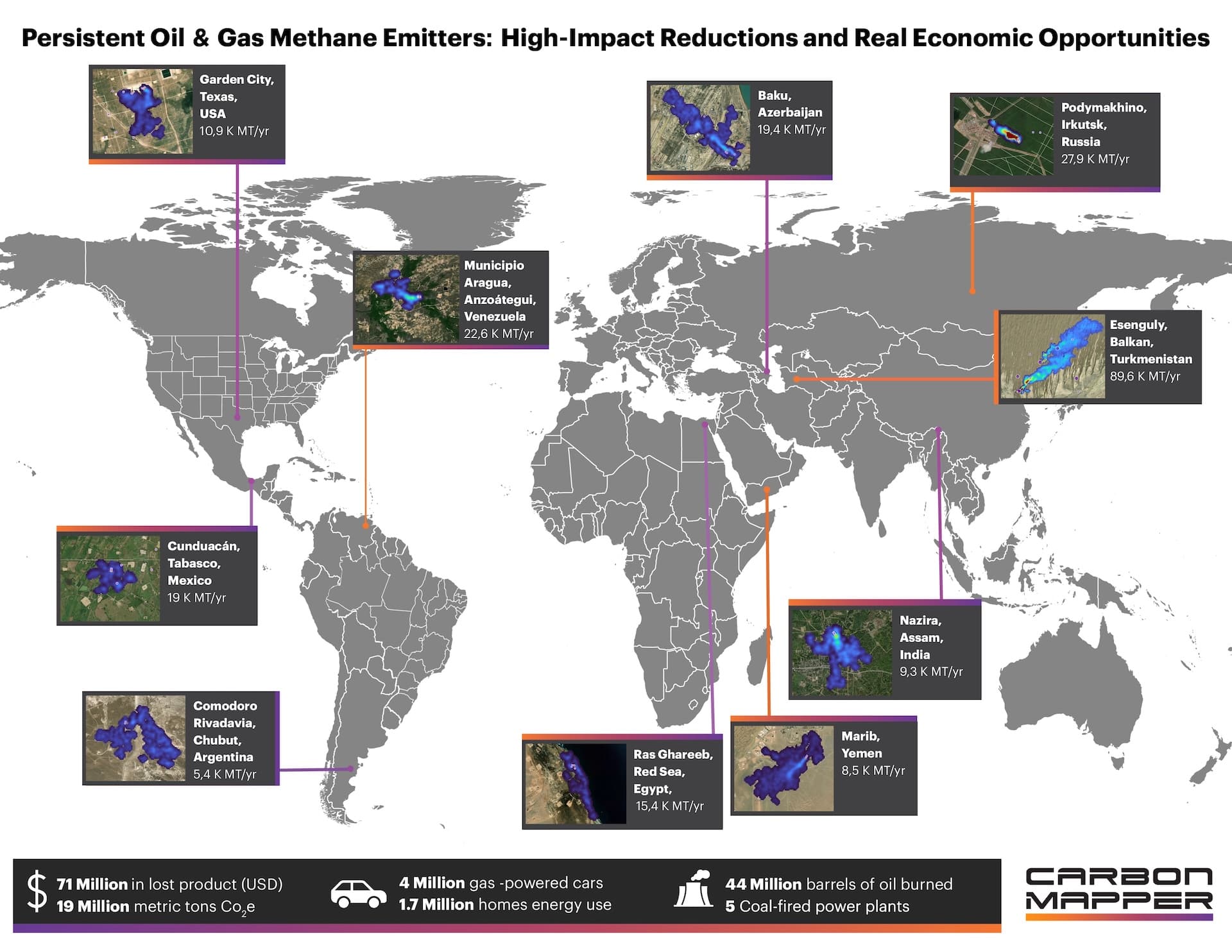
This infographic shows that mitigating emissions from these ten oil and gas sites around the world could save $71M USD in lost product and prevent the emissions equivalent of 4 million gas-powered cars. Note: A previous Carbon Mapper infographic had indicated an estimated product value of $51 million. We’ve since refined our methodology and updated this figure to more accurately reflect the overall value of the methane emitted.
Research across multiple basins shows that super-emitters like these can account for as much as 60% of total regional methane emissions in certain basins. Taken together, the ten highly persistent emitters highlighted above release over 228,000 metric tons of methane annually or 19 million metric tons of CO2e.
In practical terms, that adds up to:
Approximately $71 million USD in lost product annually. Assuming a repair cost of $520/t, the recovered gas would cover around 60% of the total mitigation cost. Actual abatement costs vary, and recent reports suggest a significant portion of emissions could be abated at much lower, or even net-zero, cost.
Enough energy to generate more than 1.8 million MWh of electricity, roughly equivalent to the annual output of 1-2 mid-sized power plants — assuming a benchmark plant produces ~1,000,000 MWh/year ( 200–300 MW units at ~50% capacity factor)1.
This is not an exhaustive list of persistent emitters, but rather an example of ten locations where timely action would deliver disproportionate climate and economic benefits relative to the time and investment required.
Bringing the Methane Emissions Challenge into Focus
Highly persistent super-emitters are low-hanging fruit in the urgent effort to slow near-term warming. For years, methane mitigation was constrained by limited visibility into where emissions were taking place. Today, groups like Carbon Mapper are providing access to high-resolution satellite emissions data to support governments, industry and civil society as they work to reduce methane emissions.
As Carbon Mapper continues to analyze new satellite observations, these figures will evolve — providing an even clearer picture of the challenges and opportunities in tackling fugitive methane across the oil and gas, waste, coal, and agricultural sectors.
Methane data is only one piece of the methane action puzzle, the challenge – and opportunity – is acting quickly on what we can now clearly see. Carbon Mapper is committed to collaborating with industry, governments, community organizations, and other stakeholders to translate data into timely, lasting emissions reductions.
Collaborating with Carbon Mapper
Learn more about these sites and others on Carbon Mapper’s public data portal or reach out to us at info@carbonmapper.org to discuss how we can work together to drive methane action.
1 EIA natural gas conversion of 7721 btu (0.007721 MMBTU) per KWH - https://www.eia.gov/totalenergy/data/monthly/pdf/sec12_7.pdf | 1 mmbtu= 129.5 kwh | 14,464,934.5 x 129.5 = 1,873,209,000 kwh = 1,873,209 MWH | Capacity factor of 50-60% = 936,605 - 1,123,925 MWh | Based on - https://www.eia.gov/electricity/annual/html/epa_04_08_b.html