What are Persistent Methane Super-Emitters? Why These Emissions Matter and How They are Tracked
Published on: Feb 26, 2026
Explainer Series
This post is part of Carbon Mapper’s Methane Remote Monitoring Education Series, which intends to help build a base knowledge of important topics in the methane monitoring space and demystify key concepts that are important to Carbon Mapper’s mission.
Addressing methane super-emitters presents a big, near-term climate opportunity, supported by a robust body of research and implementation projects. As the necessity to mitigate methane grows, so does the focus on persistent super-emitters to make big emissions reduction gains in key sectors around the world.
In this educational post, we explain what persistent super-emitters are, how they can be identified, quantified, and tracked, and how this intelligence is unlocking new opportunities for companies, cities, jurisdictions, and countries alike to target solutions that deliver on their emissions reductions targets.
Defining Persistent Methane Oil and Gas Super-Emitters
A super-emitter event is typically any emission, leak, or release of large amounts of methane, and they occur in the energy, waste, and agriculture sectors. Specifically, in the oil and gas sector, methane super-emitters are defined by the U.S. Environmental Protection Agency (EPA) as events that emit at least 100 kilograms of methane per hour. These emissions are highly complex and variable, but can generally be categorized across three time scales.
- Intermittent sources: Super-emitter events can occur in short “bursts” through intentional venting or flaring required for safety, such as planned maintenance events, pipeline blowdowns or equipment purging.
- Persistent super-emitters: Some methane emissions can last for days or weeks, resulting from equipment malfunctions or longer-term maintenance efforts. While some persistent sources are captured through leak detection protocols, satellite observations can help close the gap between source identification and mitigation.
- Highly-persistent super-emitters: Other super-emitters can last for months, or years on end — stemming from serious equipment malfunctions or failures like pipeline leaks, or management practices. These are often unknown to the operator and are not being captured by existing leak detection protocols. Satellites provide an optimal way to identify these sources that may be otherwise unseen and unaddressed.
How We Identify, Quantify and Track Persistent Super-Emitters
Remote sensing technologies with certain capabilities (including satellites or airborne instruments) are designed and optimized to detect and track persistent super-emitters at a global scale. The Tanager-1 satellite, launched in August 2024 and owned and operated by Planet, is one example of a technology that is bringing greater transparency to these large emissions sources.
Carbon Mapper uses observations from Tanager-1 to detect, pinpoint, and quantify super-emitters at the scale of individual facilities or infrastructure. This level of granularity is necessary to inform effective mitigation action. We make this emissions data available for noncommercial use through our public portal. We also use it to advance cutting-edge scientific research and public insights, underpin our important work with partners, and grow capacity to act — supporting and accelerating emissions reductions globally. Learn more about how Tanager’s technology allows us to “see” methane emissions.
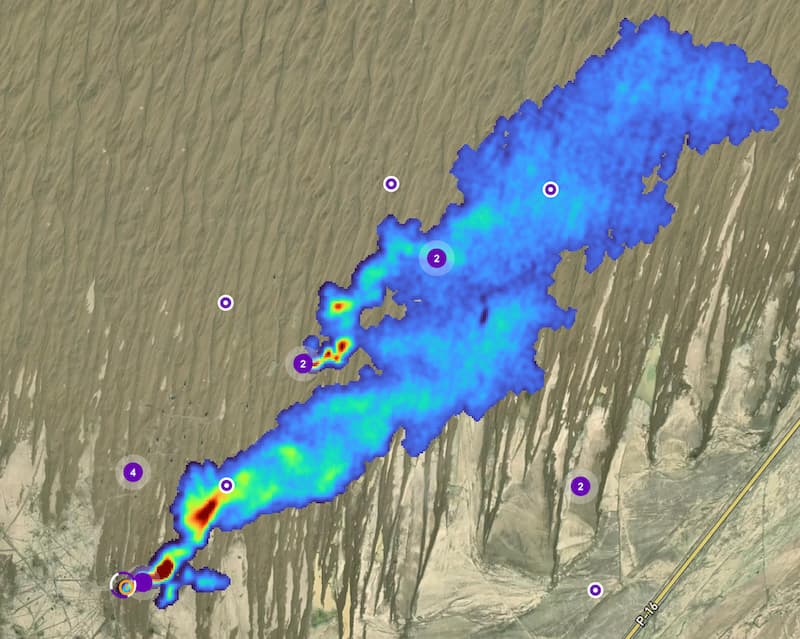
Methane plumes from the Carbon Mapper data portal from the oil and gas sector in Turkmenistan.
To gather data on super-emitters and determine how persistent they are, Carbon Mapper takes the following steps:
- We use remote sensing technology that can reliably detect super-emitter events at the level of granularity needed to attribute the event to a specific source (like a leaking pipeline or malfunctioning flare).
- We quantify emissions events using a robust, peer-reviewed methodology — yielding an emissions rate (represented in kilograms of methane per hour).
- We revisit sites to determine the duration of the super-emitter event and whether these emissions persist over time.
This strategy yields information that helps us draw conclusions about the location, potential cause, and scale of an emissions event — as well as gain insight into the potential duration.
Why Persistent Super-Emitters Matter
A spotlight on the Permian Basin
A 2025 Insight Brief and complementary 2026 study in Nature Communications highlighted results from airborne surveys of oil and gas infrastructure in the New Mexico Permian Basin from April 30 to May 17, 2024. The campaign covered 276,000 wells, 1,100 compressor stations, 175 gas processing plants, and 27,000 km of pipeline. The team found over 500 super-emitting sources with 300 of these sources observed repeatedly across multiple days. A small subset of sources (18 total) persistently emitted throughout the 13-day campaign, representing a near-term opportunity for mitigation.
When compared to estimates of total methane emissions across this region, Carbon Mapper researchers found that together, these super-emitters contribute approximately 50% towards total regional emissions, highlighting the need for frequent, wide-area monitoring.
The global opportunity of addressing persistent super-emitters
Addressing persistent super-emitters also offers an opportunity for global leaders to make significant gains toward meeting targets or commitments, like the Global Methane Pledge.
Persistent emissions in the waste sector
Sustained emissions are not limited to the oil and gas sector. In fact, Carbon Mapper data show that waste sector emissions can be highly persistent, stemming from landfills and dumpsites around the world. Using airborne and satellite data, Carbon Mapper has conducted extensive research on landfill methane in the U.S. and beyond to help society better understand the nature of these sources.
Two peer reviewed studies — including a November 2024 study on the prevalence of large emissions from the landfill work face and a March 2024 study of the largest measurement-based landfill methane assessment to date — show that landfill emissions tend to occur over long periods of time and identify major emission sources that can be prioritized for mitigation action.
Working with Stakeholders to Turn Methane Data into Action
Data is just one piece of the puzzle. Making sure it drives mitigation action is vitally important. That’s why we work with a variety of stakeholders like industry leaders, operators, regulators, and others to share our data and empower science-based, informed decisions.
An example from the U.S. is our work with the State of California to address super-emitters in key sectors through the California Satellite Methane Project. In fall 2025, the State announced that data from Carbon Mapper helped California identify and mitigate 10 large methane events at oil and gas facilities over six months. These are encouraging results as the work continues to scale
Scaling up Global Methane Monitoring
Our ability to revisit persistent super-emitters with greater frequency will increase as we grow the constellation of Tanager satellites. Our partners at Planet have committed to three additional satellites in the coming years, allowing Carbon Mapper to expand monitoring capabilities, improving access to methane emissions data, and supporting enhanced mitigation action — all steps that are pivotal to reducing local and global emissions.