Research: The Design, Strategy, and Performance of the Carbon Mapper Emissions Monitoring System
Published on: Dec 15, 2025
New research published in Atmospheric Measurement Techniques shares early results from Carbon Mapper’s satellite-based emissions monitoring system and the first 11 months of data from the Tanager-1 satellite. The article, authored by experts at Carbon Mapper, Planet Labs PBC, NASA Jet Propulsion Laboratory (JPL), Stanford University, and University of Michigan, describes the design, observational strategy, and impact of the Carbon Mapper emissions monitoring system.
About the Carbon Mapper Monitoring System
Given the rise in demand across the public sector, corporates and civil society to stabilize and reduce greenhouse gas (GHG) emissions, there is a corresponding need for emissions data that is accurate, timely, and trusted.
In this context, the Carbon Mapper monitoring system contributes significantly to the broader ecosystem of greenhouse gas observations by locating and quantifying methane and CO2 super emitters at facility scale across priority regions, making the data accessible and actionable - optimized for mitigation impact.
It is designed to contribute to the growing ecosystem of methane observations by combining regional coverage, high precision, and ultimately high frequency sampling.
The Carbon Mapper emissions monitoring system is more than just the Tanager-1 satellite. It includes:
- Observational technologies: multiple observing platforms including Tanager satellites, aircraft, and NASA’s EMIT instrument onboard the International Space Station.
- An operational monitoring strategy: routinely monitoring high emissions point sources in key global regions to assess their variability and persistence.
- A data delivery platform: that delivers actionable, accessible, and transparent CH4 and CO2 data products for diverse stakeholders.
System Performance Highlights
A review of the first 11 months of Tanager-1 methane and CO2 observations indicates that the system is meeting performance requirements and, in many cases, surpassing expectations. The satellite’s detection limit, spatial resolution, and Carbon Mapper’s emissions estimates have been validated with coordinated aircraft under-flights and non-blind controlled release testing. Plus, Tanager’s observations are offering a unique look into methane emissions that are only now possible thanks to the satellite’s unique capabilities.
Here are a few examples:
Observing Emissions in Challenging Geographies
Tanager-1 has been particularly successful in unveiling emissions in traditionally hard-to-observe sources and regions of the world. Thanks to its high resolution and wide area coverage, Tanager detections have enabled Carbon Mapper to identify and quantify methane in high latitudes, persistently cloudy regions, and offshore oil and gas infrastructure.
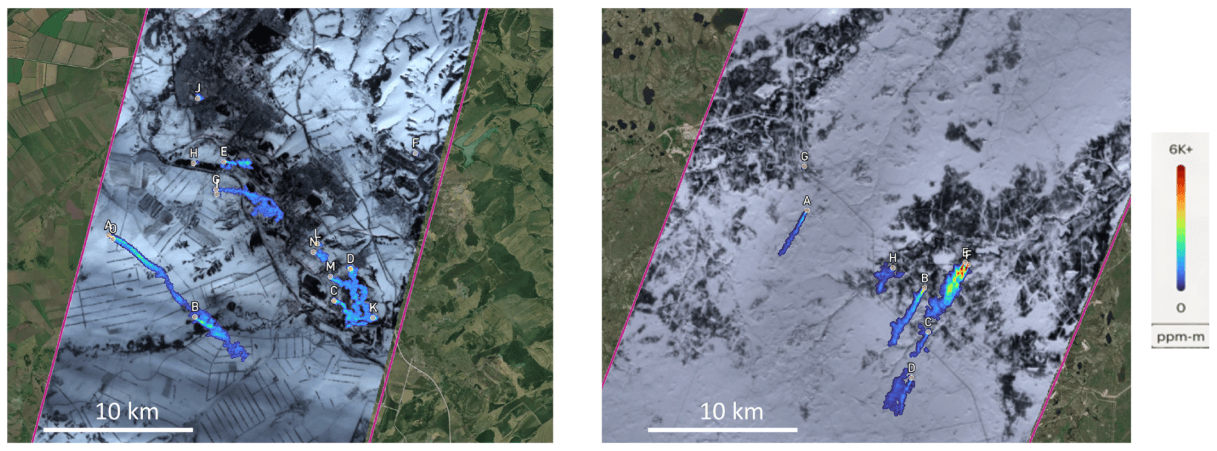
Two examples of Tanager’s CH4 detection capabilities for challenging high latitude winter images in Russia due to large solar zenith angles and low SWIR albedo due to snow covered surfaces. (left) 20x20 km2 subset of a Tanager-1 image at 55°N latitude with 13 CH4 plumes detected on 23 February 2025 at 05:51:06 UTC. Emission estimates for the plumes in this image range from 400 to 2500 kgCH4 h-1. (right) 24x24 km2 subset of a Tanager-1 image at 66 ° N with 6 CH4 plumes detected on 26 February 2025 at 06:54:41 UTC. Emission estimates for plumes in this image range from about 670 to 5000 kgCH4 h-1. In both figures the small letters denote individual plumes. The basemap overlaid by the Tanager image in each case is ©Mapbox, ©OpenStreetMap, and ©Maxar.
Identifying and Tracking Persistent Super-Emitters
Carbon Mapper has tested Tanager-1's ability to track individual super emitters at regular intervals. The image shows one example with a time-series of CH4 plumes detected by Tanger-1 at a persistently emitting oil and gas production site in Algeria. This site was observed on monthly basis from Oct. 2024 – June 2025. The persistent but variable emissions stemming from this source are not unusual. Globally, roughly 30 % of the CH4 sources detected multiple times by Tanager-1 to date are at least 50 % persistent. This includes all sectors – oil and gas, coal, waste and agriculture.
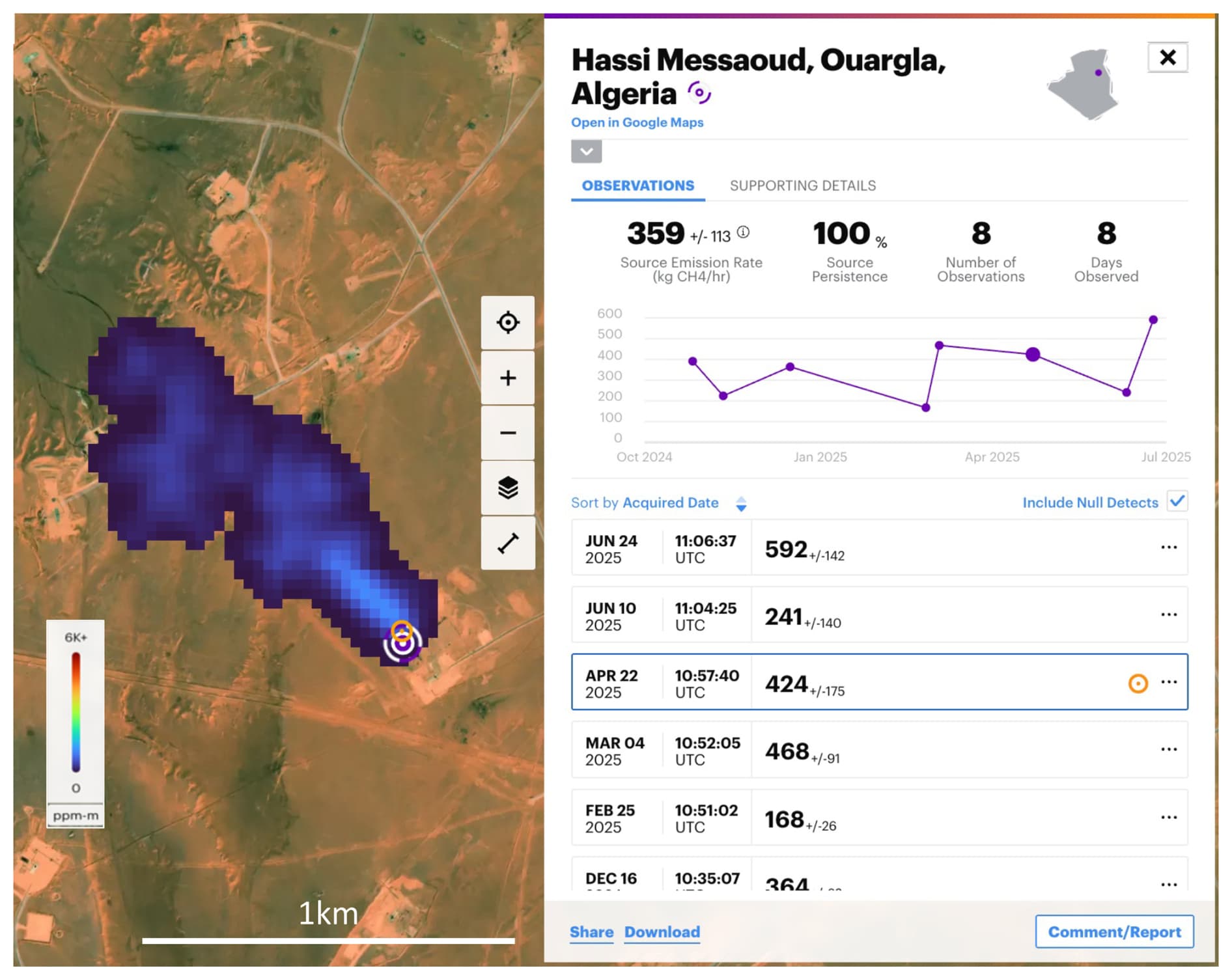
Screenshot from Carbon Mapper’s public data portal showing a time series of CH4 plumes detected by Tanager-1 at a persistently emitting oil and gas production site in Algeria. Tanager-1 observations occurred on a roughly monthly cadence from October 2024 through June 2025. Basemap image ©Mapbox, ©OpenStreetMap, and ©Maxar.
Detecting Methane and CO2 point sources
To evaluate Tanager's ability to detect CH4 and CO2 point sources simultaneously, Carbon Mapper observed some cities and industrial regions that host fossil energy production, electricity generation and refineries. This resulted in numerous individual images where multiple CH4 and CO2 plumes were detected. In the below example, Tanager-1 imaged Bahrain on 1 April 2025, revealing 8 CH4 plumes from oil and gas operations and 2 CO2 plumes from gas fired power plants.
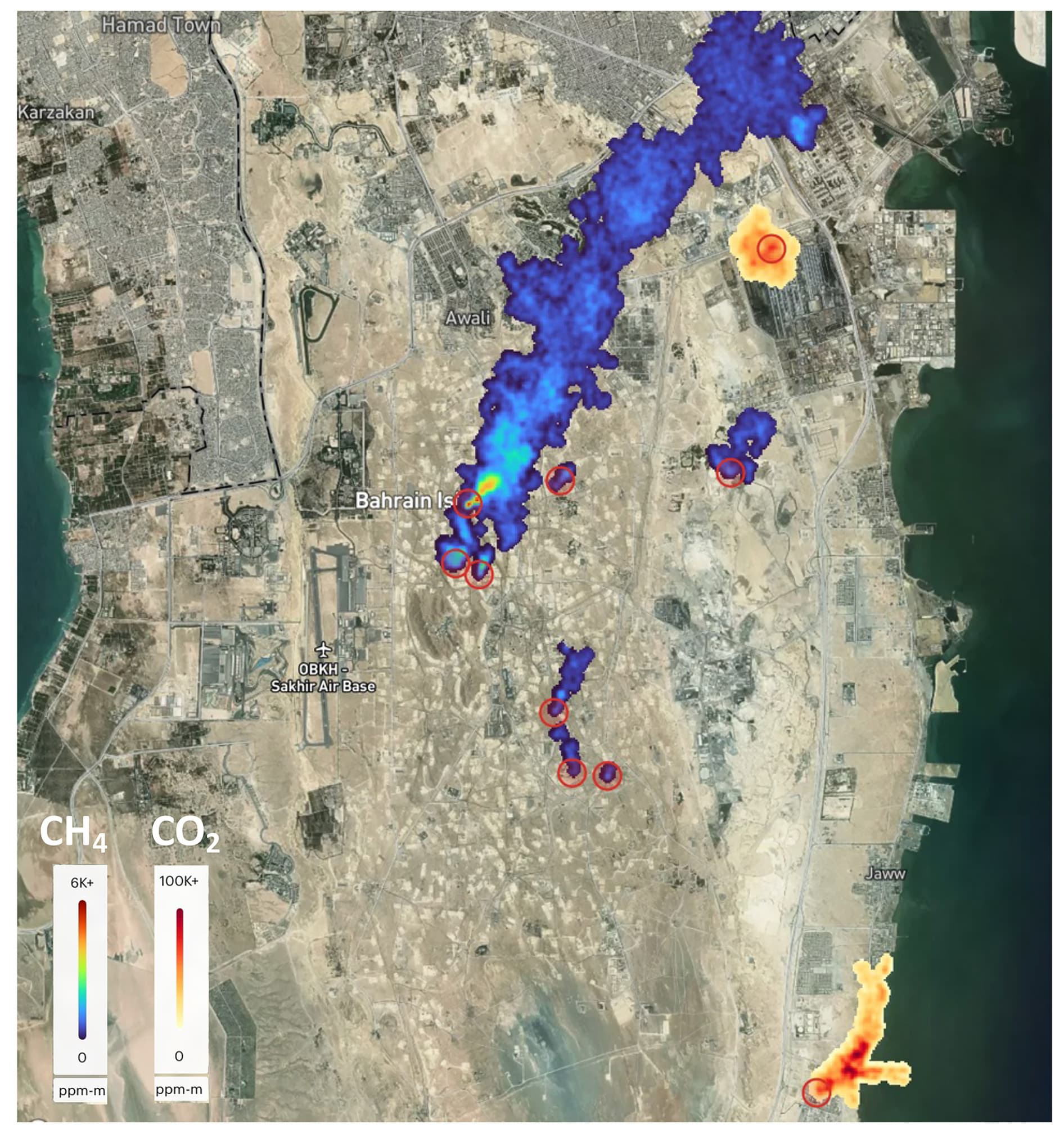
Simultaneous detection of 2 CO2 plumes and 8 CH4 plumes in a single Tanager-1 image of Bahrain acquired on April 2025. The CO2 plumes are attributed to gas-fired power plants. The CH4 plumes are attributed to oil and gas production. Basemap image ©Mapbox, ©OpenStreetMap, and ©Maxar.
Learn More
Read the full research article to learn more about the design and observational strategies of the Carbon Mapper emissions monitoring system, and initial validation of the performance of Tanager-1 – the first in a series of next generation constellation of satellites - along with a range of other capabilities including plume detection, quantification, and rapid reporting.